Peaceland: Conflict Resolution and the Everyday Politics of International Intervention
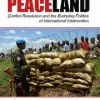
Séverine Autesserre, Assistant Professor of Political Science at Barnard College, releases her new book "Peaceland: Conflict Resolution and the Everyday Politics of International Intervention."
Website: http://www.severineautesserre.com/research/peaceland/
Book summary
Peaceland suggests a new explanation for why international peace interventions often fail to reach their full potential. Based on several years of ethnographic research in conflict zones around the world, it demonstrates that everyday elements – such as the expatriates’ social habits and usual approaches to understanding their areas of operation – strongly influence peacebuilding effectiveness.
Individuals from all over the world and all walks of life share numerous practices, habits, and narratives when they serve as interveners in conflict zones. These common attitudes and actions enable foreign peacebuilders to function in the field, but they also result in unintended consequences that thwart international efforts. Certain expatriates follow alternative modes of thinking and doing, often with notable results, but they remain in the minority. Through an in-depth analysis of the interveners’ everyday life and work, this book proposes innovative ways to better help host populations build a sustainable peace.
Availability
The book is available through the following online resellers: Amazon (U.S., JP, UK, FR, CA) and Barnes and Noble.
You can also purchase the book directly from Cambridge University Press’s website (enter discount code AUTESSERRE14 at checkout to receive a 20% discount) and many other booksellers.
For people based in the U.S., Amazon and Barnes and Noble are currently the best deal as they offer 9% off and free shipping.
The book is also available as an ebook (Kindle, Nook, and Adobe). Or you can get the hardback version, but it is much more expensive.
To request a review copy, please email [email protected] (for news media) or [email protected] (for scholarly publications). To request an examination copy, please email [email protected], providing the details of the course you are teaching. Please feel free to let me know if you don't receive the copy you requested, and I will follow up with my Cambridge directly.
Reviews
First review of the book: International Peace Institute’s Global Observatory
Advance praise:
“In this book, Séverine Autesserre makes another superb contribution to the study of peacebuilding, this time by exposing and analyzing the subculture of expatriates who participate in peacebuilding efforts on behalf of a diverse array of international and nongovernmental organizations. Many of the persistent dysfunctions of peacebuilding missions, she suggests, can be traced back to the routine practices, habits, and narratives within this subculture. It is a fascinating argument, of importance to both students and practitioners of peacebuilding.”
– Roland Paris, University Research Chair in International Security and Governance, University of Ottawa
“Scholars and practitioners have needed an ethnography of peacebuilding for quite some time – and Autesserre is one of the very few equipped to provide it. Having spent years in different conflict zones, as both an aid worker and a scholar, she knows the terrain like few others. She expertly re-creates how peacebuilders live and practice their craft; how these practices contribute to failures on the ground; and why peacebuilders, who should and do know better, seem to be incapable of changing their ways. In showing how the culture of this transnational community constructs and acts on the local scale, she does for peacebuilding what James Ferguson’s The Anti-Politics Machine did for development studies. Peaceland is a pathbreaking contribution to our understanding of the contemporary practice of peacebuilding – and global politics.”
– Michael Barnett, University Professor of International Relations and Political Science, Elliott School of International Affairs, George Washington University