Hollis Lynch and the Question of African Studies at Columbia
Blog post 04/03/26 - Dr. Jinny Prais
By Dr Jinny Prais
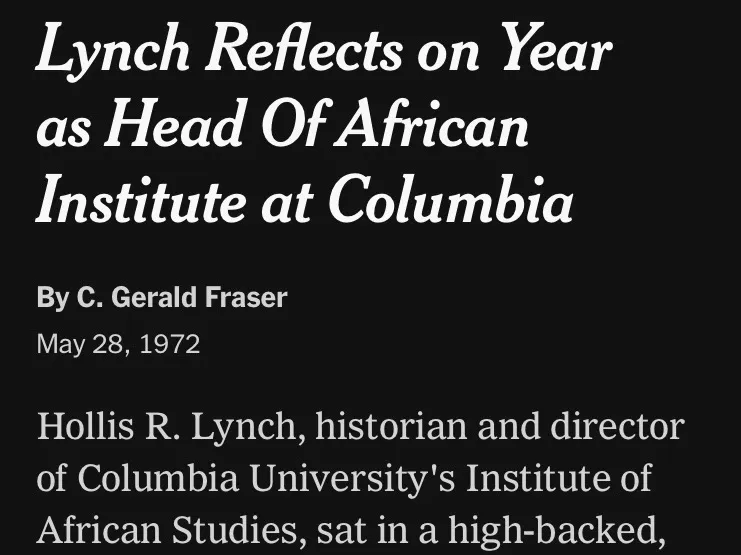
In 1972, historian Hollis R. Lynch sat in his office as director of Columbia University’s Institute of African Studies and delivered an assessment of his first year: “We have survived.”
The comment, reported in a New York Times article that year, captured a moment of uncertainty that closely resembles today’s circumstances. The Institute, Lynch explained, had lost multiple faculty members, funding sources were shrinking, and the future of African Studies at Columbia was in question. Beyond Columbia, he noted that global attention had shifted, arguing that “Vietnam and President Nixon’s ‘overtures to China’ had de-emphasized Africa.”
When Lynch assumed the directorship in 1971, more than a decade after its founding in 1959, the Institute appeared close to liquidation. The university, facing broader financial constraints, required the Institute to justify its existence, which prompted extensive negotiations between Lynch and the administration.
Despite the decline in financial support for the study of Africa in the United States, Lynch argued that the continent remained essential to understanding global politics. He pointed in particular to developments in southern Africa, which he described as “one of the most glaring instances of modern fascism.” He also emphasized growing interest in Africa among African Americans and underscored the Institute’s responsibility to disseminate knowledge beyond the academy. African Studies, in his view, was outward-facing and internationally grounded.
The Institute’s work included public forums, interdisciplinary research, and engagement with contemporary political struggles. Africa was treated as central to debates about democracy, race, and global power.
The moment was historically significant for another reason. Lynch had arrived at Columbia in 1969, during a period shaped by student activism, demands for Black Studies, and broader institutional transformation. His appointment reflected an ongoing dialogue between African Studies and African American intellectual movements. His scholarship on Pan-Africanism, including his work on Edward Wilmot Blyden, reinforced the relationship between African Studies and Black Studies at Columbia.
The 1972 article thus captures African Studies at Columbia at a crossroads: financially precarious but intellectually ambitious, institutionally vulnerable yet globally relevant. The Institute survived in part because Lynch and his colleagues argued that Africa’s significance extended far beyond regional specialization.
More than fifty years later, the resonance is striking. Questions about funding, institutional structure, and the place of African Studies within broader university priorities remain. Yet the core argument articulated in 1972 still holds: Africa is essential to understanding the contemporary world, and African Studies provides a crucial space for interdisciplinary and globally engaged scholarship.
Citation
C. Gerald Fraser, “Lynch Reflects on Year as Head of African Institute at Columbia,” The New York Times, May 28, 1972.
Hollis R. Lynch. Edward Wilmot Blyden: Pan-Negro Patriot, 1832–1912. London: Oxford University Press, 1970.